

How to Read an Extended Warranty PDS
But understanding a PDS doesn't have to be difficult.
Nobody reads a Product Disclosure Statement for fun.
What is a Product Disclosure Statement (PDS)?
A Product Disclosure Statement, usually called a PDS, contains important information about a financial product.
It explains how the product works, including its benefits, limits, exclusions, conditions and other important terms.
For an extended warranty, the PDS can also explain what you need to do to maintain the warranty and the process to follow if you need to make a claim.
WHAT'S COVERED
What the warranty may provide cover for and any applicable claim limits.

YOUR RESPONSIBILITIES
Your responsibilities, such as servicing and maintaining the vehicle.

WHAT'S NOT COVERED
Excluded parts, events and circumstances where cover may not apply.

MAKING A CLAIM
What to do when something goes wrong and the process for having a claim assessed.


First Things First — Is the Vehicle Eligible?
Before comparing cover levels, benefits or premiums, check whether the vehicle is actually eligible for the warranty.
Extended warranty products can have eligibility rules based on factors such as the vehicle's age, kilometres travelled, make or model, vehicle type and intended use. These requirements vary between products, so always check the PDS and any other applicable warranty documentation.
Let's Look at a Real PDS Example
VEHICLE AGE
The vehicle's age can determine which levels of warranty cover may be available.
KILOMETRES TRAVELLED
The odometer reading can also determine which cover levels the vehicle may qualify for.
COVER LEVEL
Each cover level can have different age and kilometre eligibility limits.
VEHICLE CATEGORY
The vehicle's make and model may be assigned to a category that can affect the warranty premium.
How Eligibility Can Change by Cover Level
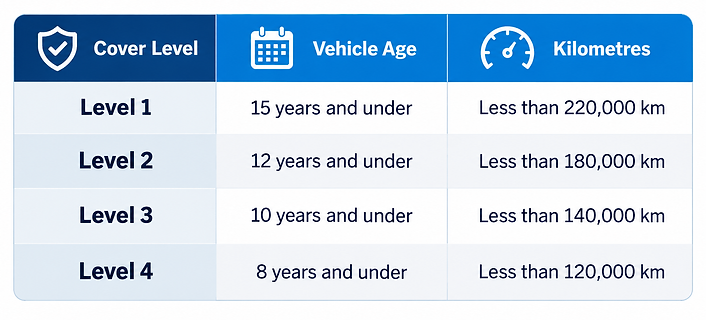
Example based on the Integrity Absolute Motor Vehicle Warranty PDS supplied for this guide. Product terms and eligibility requirements can change. Always refer to the PDS and warranty documentation applicable to the product you are considering.
What does this tell us?
A PDS may describe several levels of cover, but your vehicle may not qualify for every level. Check the eligibility requirements before comparing the benefits of each option.
Definitions — Why the Words Matter
A PDS may give familiar words a very specific meaning. Those definitions can affect how the warranty operates and how a claim is assessed.
BREAKDOWN OR FAILURE
This doesn't simply mean something needs repairing. In the example PDS, a Breakdown or Failure is a sudden and unexpected failure caused by a permanent mechanical, electrical or electronic fault that causes the component to stop working and require repair or replacement.
CLAIM LIMIT
The maximum amount payable for the repair or replacement of a particular covered component for a single claim. Different levels of cover can have different claim limits.
WEAR AND TEAR
In the example PDS, Wear and Tear refers to a component reaching its intended lifespan and naturally and inevitably requiring replacement. This is important because Wear and Tear is also listed as an excluded event.
MARKET VALUE
Sometimes a defined term affects the amount of cover. In this example, Market Value has a specific meaning based on the vehicle's trade value, rather than simply what the owner believes the vehicle is worth.
What does this tell us?
Don't assume a familiar word has its everyday meaning.
If a word is specifically defined in the PDS, read that definition before deciding what the warranty does—or doesn't—cover.

What’s Actually Covered?
The name of the cover level is only the starting point.
To understand what you're buying, look at the components or events listed as covered, the claim limit that applies, and any conditions or exclusions that may affect that cover.
Using our example PDS, different levels provide different amounts of cover and different claim limits.
Covered Components
Look for the specific mechanical, electrical or electronic components listed as covered. A component generally needs to be listed before a claim for its failure can be considered.
Your Level of Cover
Different cover levels may include different components. In our example PDS, higher levels progressively include additional components, so don't assume every level provides the same cover.
The Claim Limit
Check the maximum amount payable for an individual claim. Claim limits can vary between cover levels and may significantly affect the benefit provided.
Read Cover With the Exclusions
A component being listed as covered doesn't mean every reason it might need repair is covered. The exclusions, definitions and circumstances of the failure also need to be considered.
What does this tell us?
A covered component doesn't automatically mean a covered repair.
Whether a particular repair is covered can depend on what failed, why it failed, the applicable exclusions and the terms of the PDS. A claim can only be assessed once the actual circumstances and cause of failure are known.
What Isn't Covered?
Understanding the exclusions can be just as important as understanding what's covered.

Excluded Parts
Some components may be specifically excluded from cover.
In our example PDS, exclusions include items such as batteries, wiring, fuses, globes, brake components, suspension assemblies and various other parts. The exact exclusions depend on the product and level of cover.

Excluded Events
A covered component may still not result in a payable claim if the cause or circumstances fall within an excluded event.
Examples in our PDS include wear and tear, accident or impact damage, overheating, lack of maintenance, misuse and continued operation after a fault becomes apparent.

Other Costs
Some costs associated with a repair may also be excluded or limited.
For example, the PDS may contain conditions relating to diagnosis, fluids, freight, unauthorised repairs, consequential damage or costs above the applicable claim limit.
What does this tell us?
“The component is covered” is only half the story.
You also need to understand what isn't covered and the circumstances in which cover may not apply. That's why the covered-components section and exclusions should always be read together.
Look Beyond the Repair Cover
Does the PDS include any additional benefits?
Some extended warranty products include additional benefits that may help when a covered breakdown leaves you away from home or without your vehicle.
In our example PDS, additional benefits include accommodation, car hire and towing, subject to eligibility, limits and the conditions applying to each benefit.
🏨 Accommodation — up to $300
🚗 Car Hire — up to $300
🚚 Towing — up to $300
The example PDS provides up to $100 per day for a maximum of three days for accommodation and car hire, and up to $300 for towing where the applicable conditions are met.
Don't just look at the headline benefit.
Check the dollar limit, eligibility requirements and conditions that apply before assuming an additional benefit will be available.

Your Responsibilities — Servicing & Maintaining the Vehicle
A warranty doesn't replace regular vehicle maintenance.
A PDS can set out things you must do to maintain the warranty. Servicing and maintenance requirements are particularly important because failing to meet them may affect a claim.
SERVICE ON TIME
Follow the vehicle manufacturer's recommended servicing schedule. In our example PDS, a service may be completed up to 30 days or 1,000 km either side of the scheduled interval.
USE A LICENSED WORKSHOP
The example PDS requires servicing to be carried out by a licensed mechanical workshop. It also states that services performed by the owner are not accepted.
KEEP YOUR RECORDS
Keep invoices and receipts showing the date, kilometres, work performed and parts or fluids used. These records may be requested when a claim is made.
Don't ignore a warning sign!
If a fault, warning light, unusual noise or other problem becomes apparent, continuing to drive the vehicle can cause further damage. The example PDS requires reasonable steps to prevent further damage and lists continued operation after a fault becomes apparent among its excluded events.
Something's Gone Wrong — How Does a Claim Work?
Follow the claims process before repairs are started.
Every PDS can have its own claims procedure, so always follow the instructions for your particular warranty.
Using our example PDS, the process broadly works like this:
Something Goes Wrong
If you notice a fault, warning light, unusual noise or other problem, take reasonable steps to prevent further damage.
Don't simply keep driving if doing so could make the problem worse.
Contact the Warranty Provider
Contact the warranty provider before repairs begin and provide the information requested about the vehicle and the problem.
In the example PDS, the customer is specifically instructed to call before repair work starts.
Diagnosis & Assessment
The vehicle may need to be taken to an authorised or approved repairer so the problem can be diagnosed.
The warranty provider may request information, inspect the vehicle or require further assessment before deciding whether the claim is covered.
Authorisation & Repair
If the claim is approved, the warranty provider authorises the covered repair in accordance with the PDS.
Repairs shouldn't be authorised by the customer before the warranty provider has approved the claim. The example PDS states that unauthorised repairs may result in a claim being rejected.
Important: Approval comes before repair.
Finding a fault doesn't automatically mean a repair has been approved under the warranty. The cause of failure needs to be established and the claim assessed against the cover, exclusions and conditions of the PDS.
What does this tell us?
A PDS tells you how a claim is assessed — it can't predict the outcome of a hypothetical future repair.
Whether a particular claim is payable depends on the actual fault, cause of failure, circumstances and applicable terms when the claim occurs.

What Else Should You Check?
Cancellation
Check whether you can cancel the warranty, how any refund is calculated and whether fees or previous claims can affect the amount refunded.
Transfer
If you sell the vehicle, check whether the warranty can be transferred to the new owner, any time limits and whether a transfer fee or inspection applies.
Complaints
The PDS should explain what to do if you're unhappy with the product, service or outcome of a complaint, including the provider's internal dispute-resolution process and any external dispute-resolution options.
Privacy & Other Conditions
There may also be information about privacy, changes in vehicle use or modifications, contact details and other conditions that could affect the warranty.
What does this tell us?
The PDS isn't only about what happens when the vehicle breaks down.
It also explains your rights, responsibilities and options throughout the life of the warranty.
Every PDS Is Different
We've used the Integrity Absolute Motor Vehicle Warranty PDS throughout this guide to show how an extended warranty PDS may be structured and what information to look for.
It is an example only. Other warranty products may have different eligibility requirements, definitions, covered components, exclusions, claim limits, servicing requirements, additional benefits and claims processes.
Always read the PDS that applies to the warranty you're considering before making a decision.
Still have questions?
MrWarranty can help explain factual information about the extended warranty products available through us and provide the relevant PDS for you to review.
Disclaimer: Skilled Promotions Pty Ltd (Authorised Representative No. 1308861) distributes these products on behalf of Integrity Car Care Pty Ltd (AFSL 247069). The information on this page is factual in nature and does not take into account your personal objectives, financial situation or needs. Examples from the Integrity Absolute Motor Vehicle Warranty PDS are provided for general educational purposes only. Product eligibility, cover, benefits, exclusions, limits, conditions and claims processes may vary between products and may change over time. Please refer to the current Product Disclosure Statement (PDS) applicable to the warranty you are considering before making a decision.